
Storage Units vs Pickup Storage: The Complete Guide Before Renting
TL;DR: Storage Units make sense for long-term needs and large items you access often. For short-term storage, small collections, or anything you’d rather not haul yourself, ship-to-storage services like ShipAndStorage — which use FedEx, DHL, and UPS for pickup and drop-off — cost less and skip the truck rental entirely.
You’re standing outside a self-storage facility. The lease says 12 months minimum. The 10×10 unit costs $185 a month. You need it for six weeks. And you’re wondering: is there a smarter way to do this?
That’s the moment most people realize the traditional Storage Units model wasn’t really built for how they actually live. Short-term moves, dorm chaos, seasonal gear, renovation gaps — none of it fits neatly inside a 12-month lease. This guide breaks down exactly when Storage Units make sense, when pickup storage wins, how the carrier-based pickup model actually works, and the terms you should know before booking either one.
What Are Storage Units, Exactly?
Storage Units are rented physical spaces — think of them as small garages you lease. They come in fixed sizes, sit inside larger facilities, and require a monthly contract to keep.
You handle everything yourself: renting a truck, driving the items over, hauling them in, and returning whenever you need something. It’s the model self-storage giants have used for decades, and it works — for a specific kind of need.
The two most common formats:
- Indoor self storage units — climate-controlled, accessed from inside a building
- Outdoor drive-up units — accessed directly by vehicle, usually cheaper
Both come with monthly leases, insurance requirements, and gate-code access hours.
What Is Pickup Storage?
Pickup storage flips the model. Instead of renting a fixed space, you pay only for the packages you actually store — and a courier collects them from your door.
ShipAndStorage runs this model through its partnerships with FedEx, DHL, and UPS. You book online, receive shipping labels, and either schedule a courier pickup or drop your packages at a carrier location. Your luggage, boxes, or sports gear ship to a ShipAndStorage warehouse, sit in secure storage, and ship back to you when you need them.
No truck. No lease. No driving to a facility at odd hours. It’s the model built for people who don’t want storage to become a second part-time job.
The Real Cost of Storage Units
Sticker prices for storage unit rental are only part of the story. Here’s what a typical monthly bill actually looks like:
| Storage Unit Size | Typical Monthly Cost | What Fits |
|---|---|---|
| 5×5 (25 sq ft) | $50–$100 | Small closet contents, a few boxes |
| 5×10 (50 sq ft) | $80–$150 | Studio apartment, seasonal items |
| 10×10 (100 sq ft) | $150–$250 | Full one-bedroom apartment |
| 10×15 (150 sq ft) | $200–$350 | Two-bedroom apartment contents |
| 10×20 (200 sq ft) | $250–$450 | Small home or three-bedroom apartment |
Add truck rental ($30–$80 per day), moving supplies, insurance ($10–$30 per month), and admin fees — and the true cost jumps 25–40% higher than the advertised rate.
For anyone renting monthly storage units short-term, that math rarely works out.
Storage Units vs Pickup Storage: Side by Side
The clearest way to see the difference is a direct comparison:
| Factor | Traditional Storage Units | Pickup Storage (ShipAndStorage) |
|---|---|---|
| Contract length | Long-term lease, usually monthly minimum | No contract; free for 6 months with round-trip shipping |
| Getting items there | Rent a truck and haul it yourself | FedEx, DHL, or UPS courier pickup, or drop-off at a carrier location |
| Getting items back | Drive to the facility during set hours | Shipped to any address you choose |
| Pricing model | Pay for empty space | Pay per package, plus shipping |
| Best for | Long-term, high-volume storage | Short-term or item-specific storage |
| Insurance | Extra fee, often required | $250 per package included; up to $2,000 optional for transit |
| Effort required | High — you handle transport | Low — the carrier handles transport |
Neither model is universally better. Each fits a different set of needs.
How ShipAndStorage Works With FedEx, DHL, and UP
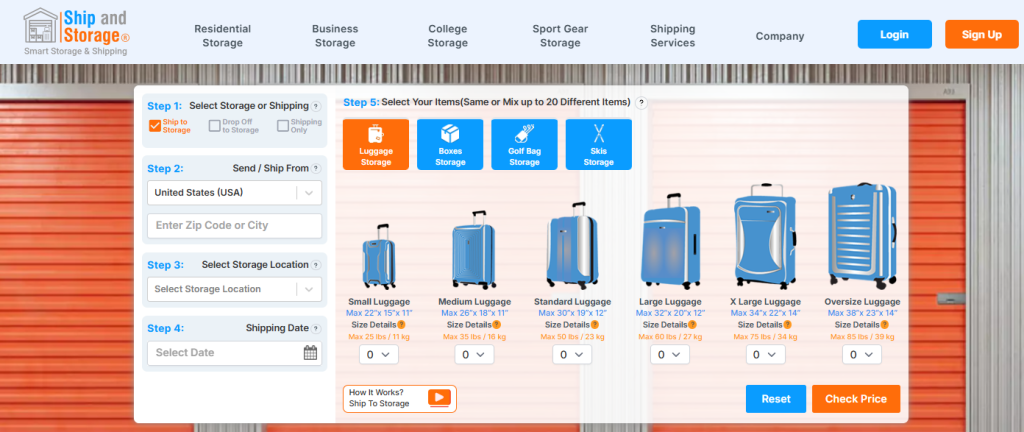
This is the part most people don’t expect. ShipAndStorage doesn’t run its own fleet of vans. It plugs directly into the FedEx, DHL, and UPS networks — which is why it can reach almost any address and offer discounted shipping rates in the process.
Here’s the full flow:
Step 1: Book Online
Enter your origin, choose the ShipAndStorage warehouse as the destination, select your shipping date and package types, and pay by card. Book at least one week ahead for domestic shipments and two weeks ahead for international.
Step 2: Receive Your Shipping Documents
Once the order is processed, ShipAndStorage emails you shipping labels plus packing and labeling instructions. If you’re in the US and booked two or three business days before your shipping date, they’ll try to mail you printed labels, tags, a label pouch, and cable ties for free — though it isn’t guaranteed. No printer? Any staffed carrier location can print your documents for you.
Step 3: Pack and Label
Pack each package securely and attach the label. ShipAndStorage doesn’t offer packing services at your home, so every package needs to be ready before pickup. Lock your bags for domestic shipments (TSA-approved locks are fine). For international shipments, leave bags unlocked and use cable ties instead — customs has the right to open them.
Step 4: Courier Pickup or Carrier Drop-Off
You have two options:
- Pickup — ShipAndStorage arranges a FedEx, DHL, or UPS pickup from your home, apartment, dorm, office, or hotel. You’ll get a pickup confirmation number two business days before the date. You don’t need to be home; a doorman, family member, or front desk can hand it over. The courier won’t call ahead and won’t bring or attach labels, so have everything ready within the pickup window.
- Drop-off — Take your labeled packages to any of the 50,000+ staffed carrier locations worldwide. ShipAndStorage strongly recommends a staffed FedEx office so you can ask for a drop-off receipt. Never use an unstaffed drop box — drop-box shipments aren’t supported.
Before the courier arrives (or before you head out), take photos of each labeled package with the barcode visible and email them to ShipAndStorage. It’s on their checklist, and it makes any later claim far smoother.
Step 5: Storage
Your packages arrive at one of two ShipAndStorage warehouses — New Castle, DE or Manhattan, NY — and free storage starts the day they’re delivered. Each package is covered for up to $250 while in storage.
Step 6: Ship Back When You’re Ready
Place a new order with the warehouse as the origin, choose any delivery address, and the carrier delivers it to your door. The carrier can also hold your shipment at a nearby location for up to five days if you’d rather collect it yourself.
For broader move planning, Consumer Reports’ moving guides offer helpful checklists that pair well with either storage approach.
Terms to Know Before You Book
Pickup storage is simple, but a few rules trip people up. Read these before you commit:
| Term | What It Actually Means |
|---|---|
| Free 6-month storage | Applies only when you ship to the warehouse and ship back using ShipAndStorage. Ship one way only, and storage is billed at $10 per package per month. |
| Storage after 6 months | $10 per package per month. |
| Self drop-off or self pickup at the warehouse | Allowed with 2 business days’ notice — but it voids the free storage, and the $10 per package per month fee applies. |
| Package limits | No side longer than 72 inches; no package over 100 lbs. Damaged, broken, or leaking packages are refused. |
| Insurance | $250 per package free. Up to $2,000 per package available for an extra fee, covering in-transit loss only. Storage coverage stays at $250. Fragile items, electronics, glassware, antiques, jewelry, and anything damaged by poor packing aren’t covered. |
| Prohibited items | Aerosols, alcohol and perfume, lithium batteries, currency, firearms, flammable liquids, perishable food, plants, hazardous materials, and other restricted goods. Check the full list before packing. |
| Pricing | Shipping cost depends on distance, package size, and weight. The carrier weighs and measures each package after pickup and bills the actual chargeable weight, so pick accurate sizes when booking. Quoted prices don’t include pickup or insurance fees. |
| Cancellation | Full refund if you cancel within 24 hours and no labels were issued. After that, a $20 cancellation fee applies. Edits after processing may also carry a $20 fee. |
| Storage locations | US only — New Castle, DE and Manhattan, NY. |
| Claims | Damaged or lost shipments must be reported within 3 business days, with photos and an item list. Claims take 2–6 weeks. |
None of this is complicated. It’s just different from a storage unit, and knowing it up front means no surprises on the invoice.
When Traditional Storage Units Make Sense
Not every situation calls for pickup storage. Storage Units are still the right answer when:
- You need storage for a full year or longer and don’t plan to ship items back
- You’re storing an entire apartment’s worth of furniture
- You need frequent, drive-up access to items
- You already own a truck or SUV and don’t mind hauling
- You have oversized or heavy items beyond the 72-inch, 100-lb package limits
If any of that describes your situation, searching storage unit near me and comparing local facilities is the right move. Just know what you’re getting into — the model demands more from you than it might appear.
When Pickup Storage Wins
For pretty much everything else, pickup storage is simpler, cheaper, and faster. Common winning scenarios:
- Short-term storage (a few weeks to six months)
- Dorm storage during summer or winter break
- Between-move storage when leases don’t line up
- Seasonal gear — ski equipment, golf bags, snowboards
- Luggage you don’t want to carry — before a trip, between destinations, or on the way home
- Renovation-window storage for boxed household items
If you don’t want to think about how to rent a storage unit — or worse, drive to one — the carrier-based pickup model was designed for exactly that.
Which One Should You Choose?
Here’s the simplest test:
- Storing an entire apartment for a year or more, with regular access? Rent a Storage Unit.
- Storing packable items you’d rather have shipped than hauled? Pickup storage almost always wins.
For short-term, item-specific, or hassle-free storage, ShipAndStorage’s residential storage is the modern answer.
FAQs
What are Storage Units and how do they work?
Storage Units are rented physical spaces inside a self-storage facility. You sign a monthly lease, transport items yourself, and access them during set facility hours.
How much do Storage Units cost per month?
Prices range from $50 for a small 5×5 unit to $450 or more for a 10×20 unit. Truck rentals, insurance, and admin fees typically add 25–40% to the sticker price.
How does ShipAndStorage pick up my items?
ShipAndStorage arranges a FedEx, DHL, or UPS courier pickup from your address. You receive a confirmation number two business days before the pickup date, and you don’t need to be home as long as someone can hand over the labeled packages.
Where can I drop off packages for ShipAndStorage?
At any of the 50,000+ staffed FedEx, DHL, or UPS locations worldwide. A staffed FedEx office is recommended so you can get a drop-off receipt. Drop boxes are not accepted.
Is ShipAndStorage’s 6-month free storage really free?
Yes, as long as you ship to the warehouse and ship back using ShipAndStorage. If you ship only one way, or drop off or collect at the warehouse yourself, storage costs $10 per package per month.
What are the standard storage unit sizes?
Common sizes are 5×5, 5×10, 10×10, 10×15, and 10×20 square feet — roughly matching closet, studio, one-bedroom, and small-home volumes.
What’s the difference between self storage units and pickup storage?
Self storage units require you to rent, transport, and manage the space yourself. Pickup storage uses carriers to collect and return your packages, and you pay per package instead of per square foot.
Are my items insured with pickup storage?
Each package is insured for up to $250 at no cost. You can add up to $2,000 per package for in-transit loss. Fragile items, electronics, and prohibited goods aren’t covered.
What can’t I store or ship?
Anything over 72 inches on a side or 100 lbs, plus restricted items like aerosols, alcohol, lithium batteries, firearms, flammable liquids, perishable food, and hazardous materials.
Where are ShipAndStorage’s warehouses?
Two US locations: New Castle, DE and Manhattan, NY. There’s no storage outside the US.
How early should I book pickup storage?
At least one week ahead for domestic shipments and two weeks for international — earlier during peak moving and college move-out seasons.
Final Thoughts
Storage Units aren’t going away — and for long-term, high-volume needs, they still make sense. But for most modern storage scenarios, the traditional model is overkill. Contracts are longer than the actual need. Truck rentals add friction. And paying for empty square footage doesn’t reflect how people use storage anymore.
If your storage need is short-term, packable, or just too much of a hassle to handle yourself, a carrier-backed pickup model was built for you. Book the round trip, follow the packing rules, and let FedEx, DHL, or UPS do the driving.
Book pickup storage with ShipAndStorage today — courier pickup or carrier drop-off, no long-term contract, and six months free with round-trip shipping.


